If you've ever announced a pet's death on social media, you've probably used the phrase.
"He crossed the rainbow bridge last Tuesday."
"She's at the rainbow bridge now, running free."
The language is so embedded in how we talk about pet loss that most people who use it have never read the actual poem it comes from. And for most of its existence, nobody knew who wrote it.
That changed in 2023. And the story of how the Rainbow Bridge poem finally found its author — after more than sixty years of anonymity — turns out to be one of the more quietly extraordinary stories in recent literary history.
The Poem Itself
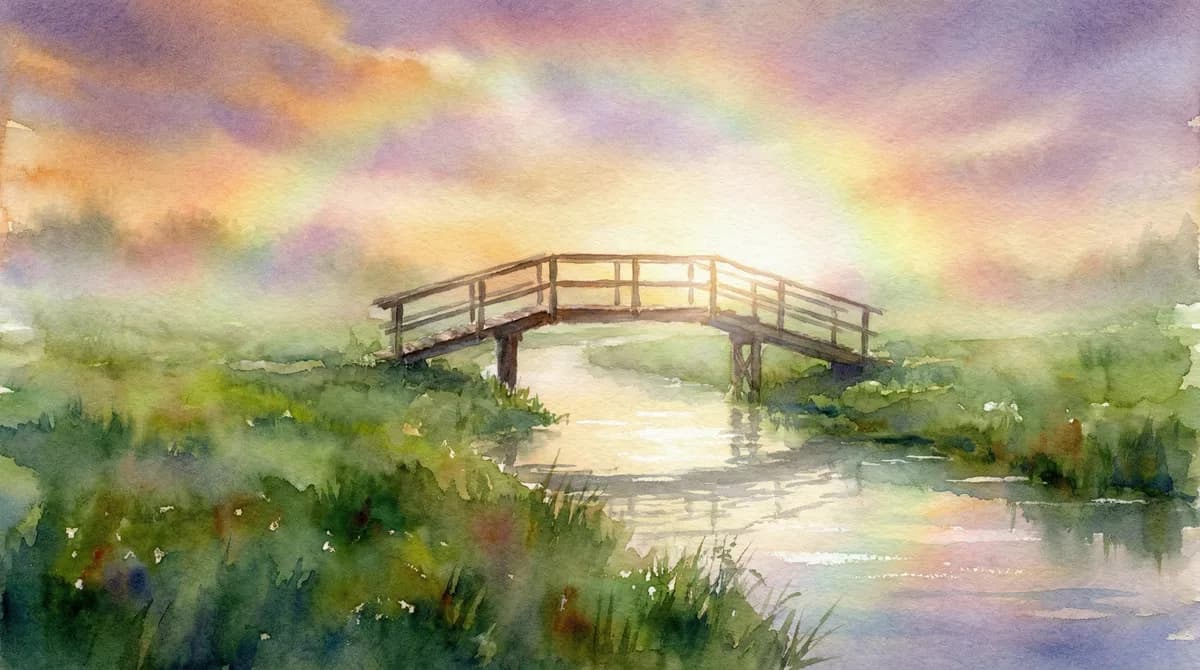
Just this side of heaven is a place called Rainbow Bridge.
When an animal dies that has been especially close to someone here, that pet goes to Rainbow Bridge. There are meadows and hills for all of our special friends so they can run and play together. There is plenty of food, water and sunshine, and our friends are warm and comfortable.
All the animals who had been ill and old are restored to health and vigour. Those who were hurt or maimed are made whole and strong again, just as we remember them in our dreams of days and times gone by. The animals are happy and content, except for one small thing; they each miss someone very special to them, who had to be left behind.
They all run and play together, but the day comes when one suddenly stops and looks into the distance. His bright eyes are intent. His eager body quivers. Suddenly he begins to run from the group, flying over the green grass, his legs carrying him faster and faster.
You have been spotted, and when you and your special friend finally meet, you cling together in joyous reunion, never to be parted again. The happy kisses rain upon your face; your hands again caress the beloved head, and you look once more into the trusting eyes of your pet, so long gone from your life but never absent from your heart.
Then you cross Rainbow Bridge together…
The Story Nobody Knew
For most of the late twentieth century and into the 2000s, the poem circulated without an author. It spread through 1980s internet forums and email chains — those early networks of pet lovers who recognised something true in its words. By the time social media arrived, it had been shared millions of times, universally attributed to "Anonymous."
Multiple people claimed to have written it over the years. Researchers disputed these claims. The mystery persisted.
Then in 2023, a Scottish woman named Edna Clyne-Rekhy contacted a journalist at the Associated Press. She was 81 years old. She had been watching the poem's spread for decades, quietly knowing she had written it, and never quite feeling able to step forward.
She had written it in 1959, at the age of eighteen, after the death of her Labrador, Major. Her mother had encouraged her to write about her grief. She wrote the poem in a single sitting, titled it "Rainbow Bridge," and kept it in a notebook. She shared it with friends and family, never seeking publication, never thinking it would travel beyond those closest to her.
It travelled everywhere.
When Edna's story was confirmed — cross-referenced with the original notebook, the early distribution, the timeline — it solved one of the internet's more enduring mysteries. She was, at that point, a grandmother. She had watched her poem comfort millions of grieving strangers for more than sixty years.
Why It Works
Grief researchers and theologians have tried to understand the poem's extraordinary reach, and a few things stand out.
It fills a cultural gap. Many religious traditions have clear narratives about human afterlife. Very few address what happens to animals. The Rainbow Bridge poem offers something most traditions don't: a specific, visual, hopeful story about where pets go. It's gentle enough to align with most belief systems while being specific enough to feel real.
It restores what was lost. The poem explicitly describes old and ill pets being "restored to health and vigour" and injured animals being "made whole again." For anyone who lost a pet to age, illness, or accident — which is most people — this particular detail carries enormous comfort.
It's about reunion. The climax of the poem isn't the pet running free. It's the moment they're spotted running toward you. The poem is fundamentally about reconnection — the idea that the relationship continues, that there is a moment waiting.
It gives language to a relationship that's hard to describe. "Trusting eyes." "Beloved head." "Never absent from your heart." The language is simple but precise. It names things about the pet relationship — the particular quality of an animal's trust, the physical intimacy — that most of us feel but rarely articulate.
Rainbow Bridge Remembrance Day
Every year on August 28th, the date has been recognised as Rainbow Bridge Remembrance Day.
Pet owners around the world mark it by sharing memories of animals they've lost. Some light candles. Some revisit old photographs. Some place flowers on graves. Some share the poem itself, perhaps not knowing, until recently, who wrote it.
The day has no official institutional backing. It exists entirely because people found it meaningful, shared it, and kept it going — which is perhaps the most fitting tribute to a poem that survived and spread the same way.
What You Can Do With a Poem
The Rainbow Bridge is a starting point. It gives language to grief. It offers an image to return to.
But grief also needs objects. Photographs fade, files get lost, boxes get pushed to attics. A portrait — something made from the best photograph you have, transformed into a piece of art — is something different. It's permanent in a way that digital files are not. It's physical in a way that memories are not.
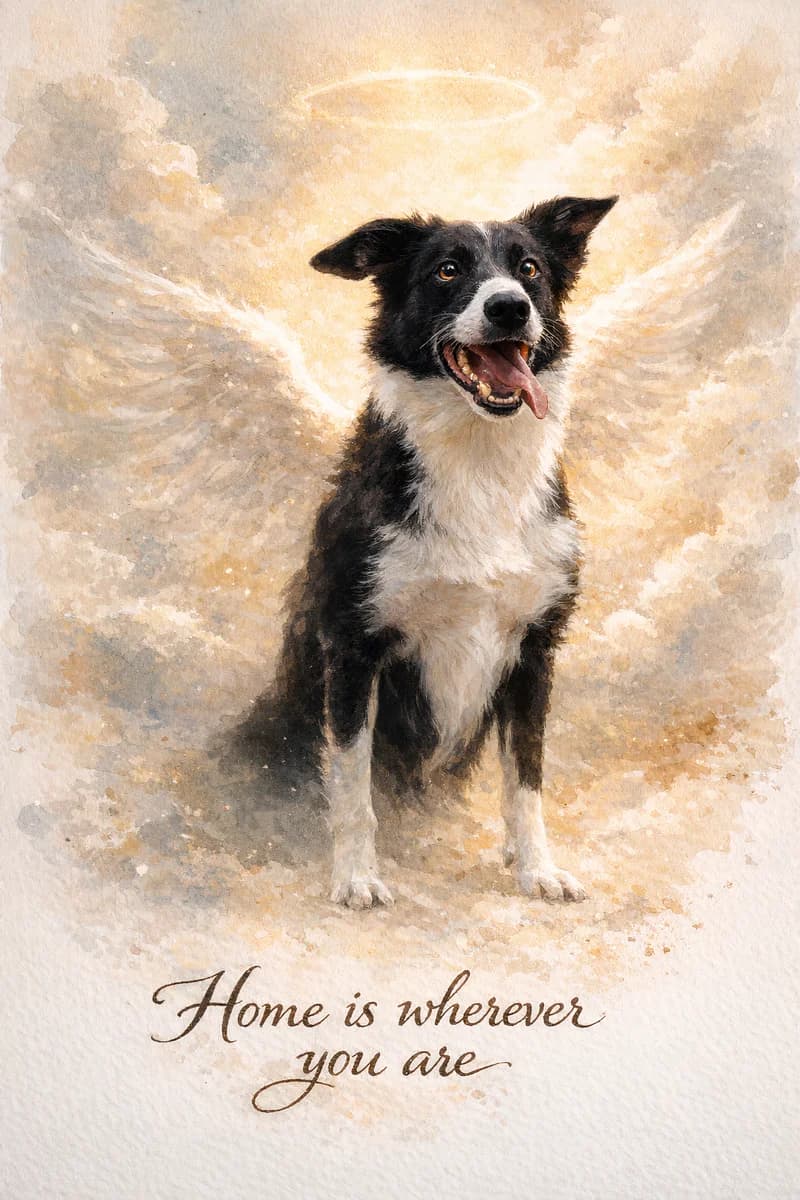 A memorial portrait in the Heaven style — golden light, peaceful background, the quality of peace the poem describes
Our Heaven style was designed with this in mind: soft golden clouds, warm ambient light, the visual language of the peace and rest the poem describes. It's the most popular style we have for memorial portraits. People who've lost an animal often say it captures something they couldn't quite name before — the specific feeling of a pet at rest, free from pain, waiting.
We offer a dedicated memorial experience at petportraitgift.com/memorial — with style recommendations specifically for remembrance, the option to add an inscription (a name, dates, a phrase), and a free preview before any payment.
👉 Create a memorial portrait — free preview →
A Final Note on Edna
Edna Clyne-Rekhy is in her eighties. She lives in Scotland. She has said in interviews that she doesn't regret not claiming authorship sooner — that the poem found its purpose without her name attached, and that perhaps that was right.
She wrote it to process her own grief, at eighteen, for a dog named Major. It became a text that has helped millions of people do the same thing.
That's an extraordinary thing for a poem to do. And for an eighteen-year-old's notebook entry to become one of the most shared texts in internet history — because it was true enough, and gentle enough, and specific enough to feel like it was written about your pet specifically — is perhaps the most fitting tribute to what animals do to us.
They leave prints. Not just paw prints. On the people who loved them.
petportraitgift creates memorial pet portraits in the Heaven, Blossoms and Watercolour styles. Free preview, free inscription, digital or canvas. See the memorial collection →