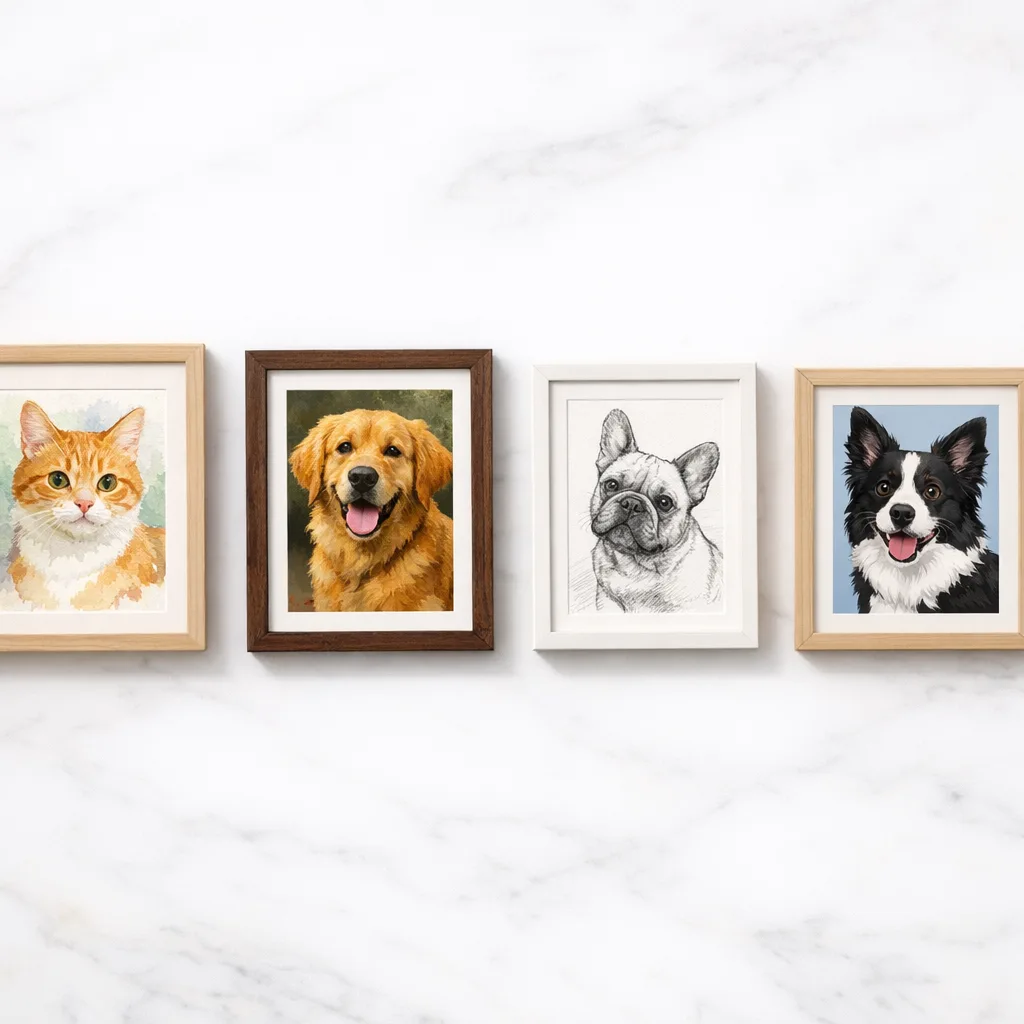
There's a term for what's been quietly happening in modern homes for the past few years.
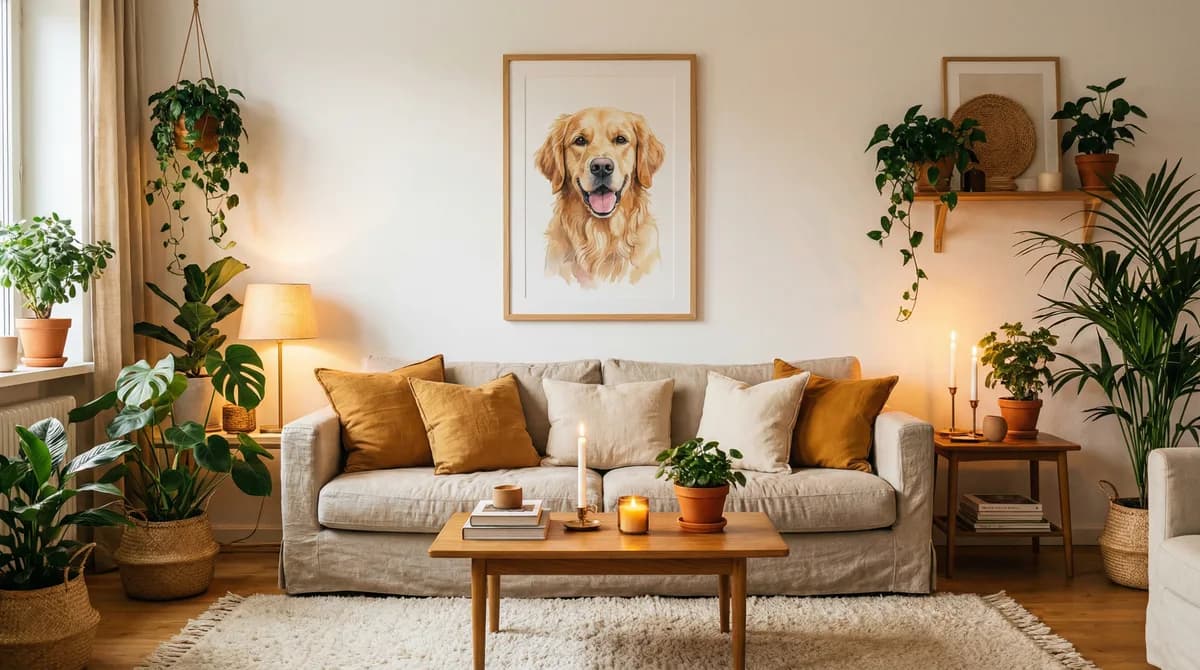
You've seen it. A living room that's warm and considered, with natural textures and a carefully chosen gallery wall — and somewhere in the middle of it, completely at home: a portrait of a dog. Not a small framed snapshot tucked on a shelf. A proper piece of art, the kind that commands attention and earns the question "where did you get that?"
Interior designers have finally given this a name. They're calling it Petcore.
What Petcore Actually Means
Petcore is the design philosophy of building a home around the reality that a pet lives there — not as an afterthought, but as a central consideration.
It's built-in kennels that look like cabinetry. Pet beds that match the sofa. Dedicated washing stations with good tile and decent fixtures. The end of trying to hide the fact that an animal shares your space.
But it's also something more quietly significant: the idea that your pet deserves to be on your walls.
The global pet care market is projected to grow from $243 billion in 2025 to $483 billion by 2035, according to Bloomberg Intelligence's pet industry analysis — making it one of the fastest-growing consumer sectors globally. A major driver is what economists call "pet humanisation" — the broad cultural shift toward treating animals as family members rather than possessions. We spend on them. We grieve them. We build spaces for them.
And in 2026, we're hanging portraits of them.
The Wall Art Shift: From Decoration to Meaning
The dominant wall art trend of 2026 has been called "warm minimalism" — a term that appeared in Architectural Digest and House Beautiful's annual design forecasts, and has since crossed over into mainstream interior design coverage. Fewer pieces, chosen more deliberately. Terracotta and cream palettes. Natural materials. And above all else: personal meaning over generic beauty.
This is precisely where custom pet portraits fit — and fit well.
A print of a generic landscape can be beautiful. A high-quality watercolour of your specific dog — the one who greets you at the door, who claims the corner of the couch, who you've rearranged travel plans around — is both beautiful and irreplaceable.
 A watercolour portrait on a living room wall — not decoration, but a statement about who lives here
The Petcore trend recognises something that pet owners have known for a long time: the animal you share your home with is part of that home's story. Decorating your walls around that truth isn't eccentric. It's honest.
What Makes a Pet Portrait Work as Wall Art
Not every pet image belongs on a wall. A phone snapshot in a plastic frame is a different thing from a piece of art. The difference comes down to a few factors:
Scale. A small print in a small frame disappears on a wall. A portrait intended for display needs to be large enough to hold the space — at minimum 30×40 cm, ideally 50×70 cm or larger for a living room wall.
Quality of the image itself. High-resolution files (we offer 3600×5400 px at 300 DPI) print beautifully at any size. Low-resolution phone photos print as blurry, pixelated impressions of what you intended.
The medium. Canvas adds texture that flat paper or glass-covered prints can't replicate. The slight depth of a gallery-wrap canvas, the way it catches ambient light — it looks more like art because it is more like art.
The style. Classic watercolour works in almost any interior. Loose brushwork, soft background washes, warm tones — it's timeless in a way that hyperrealistic digital illustration often isn't. You're not trying to replicate a photograph; you're creating something that lives alongside your furniture rather than competing with it.
Where to Put It
The placement question matters more than most people expect.
The entryway is underrated. A portrait near the front door sets the tone for the entire home — it's the first thing guests see, and it immediately signals something about the household. For dogs especially, who greet at the door, it's almost narrative: here's who lives here.
The living room gallery wall is the most common choice, and with good reason. A pet portrait mixes naturally with family photographs, travel prints, and abstract art — it doesn't demand to be the centrepiece, but it usually becomes it anyway.
The home office. If you work from home (and if you do, your pet almost certainly co-works with you), there's a strong argument for a portrait in your workspace. Something to look at when a call is running long.
The bedroom. More intimate, more personal. Particularly right for a memorial portrait, or for a pet who's primarily an indoor companion.
 The Heaven style — golden light, peaceful background — works in a bedroom or living room as a calm, permanent presence
One room that consistently doesn't work: directly above a television. Nothing does.
The "Petcore" Gallery Wall
If you're building a gallery wall with your pet at the centre, a few principles help:
Vary the frame styles. A mix of natural wood, black, and white frames looks more collected than a matching set. The portrait shouldn't look like it was bought at the same time as everything around it — even if it was.
Use odd numbers. Three prints, five prints, seven. Even numbers create symmetry; odd numbers create interest.
Let the portrait be the anchor. The pet portrait should be the largest piece in the cluster, or positioned at eye level in the centre. Everything else can be smaller and arranged around it.
Mix personal and impersonal. A watercolour of your dog next to a botanical print next to a travel photograph. The personal piece becomes more powerful for being surrounded by less personal ones.
A Portrait as a Starting Point
The interesting thing about Petcore — beyond the design language — is what it represents culturally.
For most of human history, portraits were reserved for people of significance. Royalty. Patrons. Those who had resources and status to commission art. The democratisation of portrait-making (first through photography, now through AI-based services like petportraitgift) has made the portrait accessible to everyone.
What Petcore says, implicitly, is that your pet is significant enough to be on your wall. That the relationship you have with them — however ordinary it might seem from the outside — deserves to be reflected in the space you've created together.
That's not a design trend. That's a true thing that a design trend has finally caught up to.
👉 See your pet as wall art — free preview →
petportraitgift creates custom watercolour portraits from a single photo. Digital download from $9, gallery canvas prints from $60. Free preview before purchase.